The nativity story and the figures in a nativity set
The nativity story in order, with the Bible verses behind each scene, where every figure in a nativity set comes from, when to add the baby and the kings, and what historians make of it.
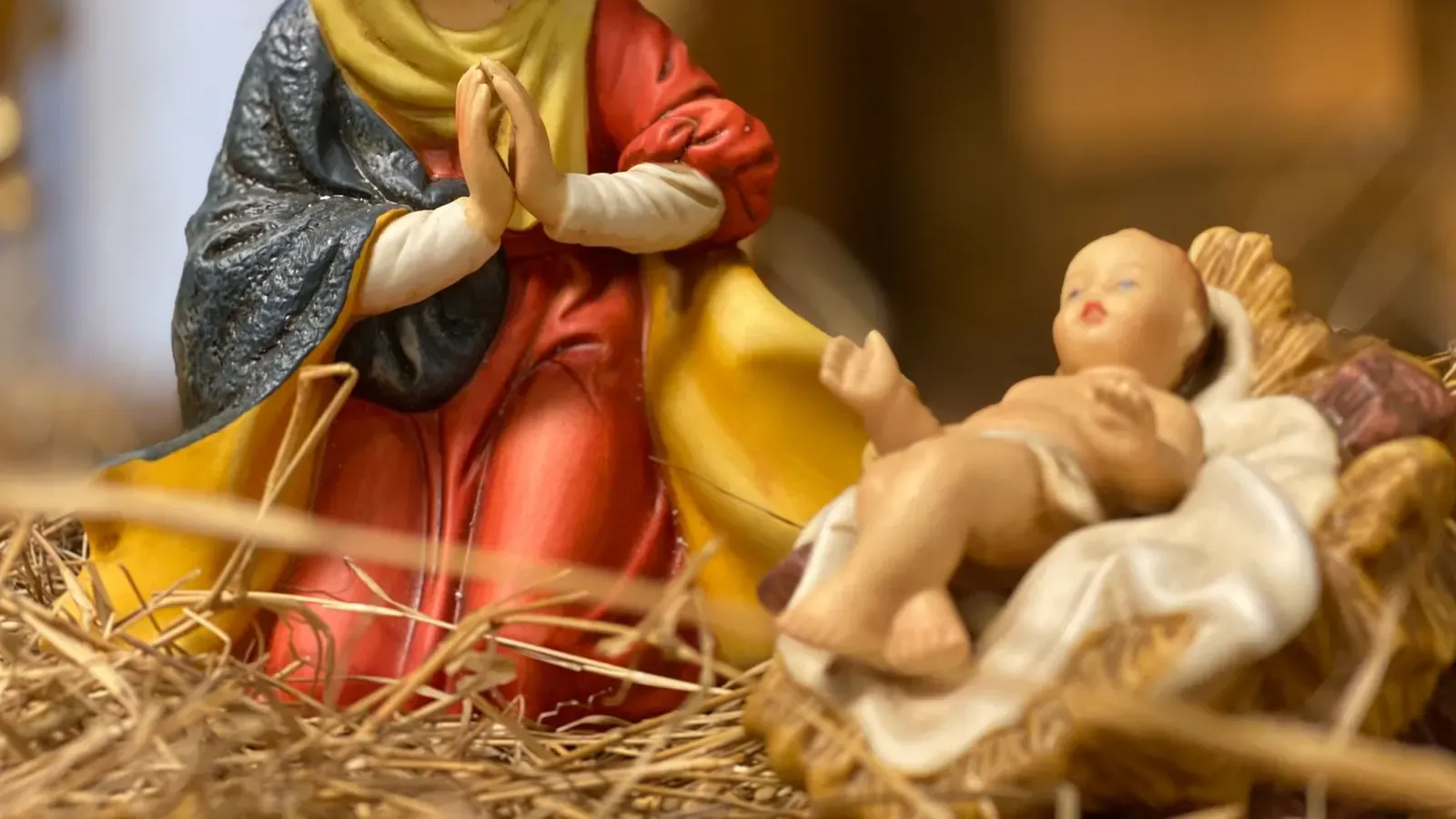
The story of the nativity is told in two books of the Bible, the Gospels of Luke and Matthew, and each tells a different part of it. Luke has the census, the manger, the shepherds and the angels. Matthew has Joseph’s dream, the star, the wise men and King Herod. A nativity set puts both versions on one shelf, and adds two animals that neither Gospel mentions. Below is the story in order with its verse references, where each figure in a set comes from, when the baby and the kings traditionally go in, and what historians say about it. Ready-made sets are gathered in our nativity sets collection.
The story of the nativity, step by step
This is the combined story in order, with the Gospel that tells each part.
| Scene | What happens | Where in the Bible |
|---|---|---|
| The annunciation | The angel Gabriel visits Mary in Nazareth and tells her she will have a son, to be called Jesus | Luke 1:26 to 38 |
| Joseph’s dream | Joseph, engaged to Mary, learns she is pregnant and plans to end the engagement quietly; an angel in a dream tells him to marry her and name the child Jesus | Matthew 1:18 to 25 |
| The census | Caesar Augustus orders a census, and Joseph, a descendant of King David, travels from Nazareth to Bethlehem with Mary | Luke 2:1 to 5 |
| The birth | Mary wraps the baby in cloths and lays him in a manger, because there is no guest room for them | Luke 2:6 to 7 |
| The shepherds | An angel appears to shepherds watching their flocks at night, a crowd of angels praises God, and the shepherds find the baby in the manger | Luke 2:8 to 20 |
| The Temple | Jesus is named on the eighth day; at the Temple in Jerusalem, Simeon and the prophet Anna recognise him | Luke 2:21 to 38 |
| The wise men | Magi from the east, who have seen his star rise, come to Jerusalem; Herod sends them to Bethlehem, the star goes ahead of them and stops over the house, and they give gold, frankincense and myrrh | Matthew 2:1 to 12 |
| The flight to Egypt | Warned in a dream, Joseph takes the family to Egypt; Herod orders the killing of the young boys of Bethlehem | Matthew 2:13 to 18 |
| Nazareth | After Herod’s death the family settles in Nazareth, in Galilee | Matthew 2:19 to 23; Luke 2:39 to 40 |
Two Gospels, two versions
Mark and John say nothing about the birth. Luke and Matthew agree on the main points: Mary and Joseph, a birth in Bethlehem and the reign of Herod the Great. The routes differ, though: in Luke the family lives in Nazareth and travels to Bethlehem for the census, while in Matthew they are in a house in Bethlehem and only move to Nazareth after Egypt.
So the wise men and the shepherds never meet in the Bible: Matthew places the Magi’s visit in a house, not at the manger. A nativity scene puts everyone round the manger at once.
God sent the angel Gabriel to tell Mary she would have a baby called Jesus. Mary and Joseph had to travel to Bethlehem, and there was no room for them, so baby Jesus slept in a manger, the box animals eat from. Angels told shepherds on the hillside, and they hurried to see him. A bright star led wise men from far away, who brought presents of gold, frankincense and myrrh.
The figures in a nativity set and where they come from
Most nativity figures come from one of the two Gospels. A few come from the Book of Isaiah, from later writers or from the way artists painted the scene.
| Figure | In the Bible? | Where it comes from |
|---|---|---|
| Mary and Joseph | Yes | Both Gospels |
| Baby Jesus in the manger | Yes | Luke 2:7; the manger is also the sign the angel gives the shepherds (Luke 2:12) |
| Angel | Yes | The angel who tells the shepherds (Luke 2:9 to 14); the angel who visits Mary in Luke 1 is named Gabriel |
| Shepherds and sheep | Yes | Luke 2:8 to 20 |
| Wise men | Yes, but not counted and not called kings | Matthew 2:1 to 12 |
| Star | Yes | Matthew 2:2 and 2:9 to 10 |
| Ox and donkey | No | Isaiah 1:3, where the ox knows its master and the donkey its owner’s manger; the 7th-century Gospel of Pseudo-Matthew |
| Camels | No | Not in Matthew’s account; they come with the picture of the Magi as travellers from the east |
| Stable or cave | No | Luke only mentions a manger; the cave follows the Grotto of the Nativity in Bethlehem |
| Innkeeper | No | Luke mentions no innkeeper at all |
| Townspeople, bakers, musicians | No | The Neapolitan cribs of the 1700s and the santons of Provence |
The three kings: three gifts, not three men
Matthew never says how many wise men came. The number three comes from the three gifts, and the word magi meant priests of the Zoroastrian religion of ancient Iran. Christian readers had turned them into kings by about AD 500, and the names Caspar, Melchior and Balthazar first appear in the Excerpta Latina Barbari, an 8th-century Latin chronicle translated from a Greek text written about two centuries earlier.
- Gold: a gift for a king.
- Frankincense: incense, a gift for God.
- Myrrh: a gift for someone who was mortal.
These meanings come from Origen of Alexandria, an early Christian writer, who was also the first to place the ox and the donkey in the stable at Bethlehem.
No room at the inn?
Older English Bibles such as the King James Version say there was no room for them in the inn. The Greek word Luke uses, katalyma, can mean an inn, a private house or a room in a house, and it is impossible to be sure which he meant; modern translations such as the NIV say guest room. That is why some nativity sets show a stable and others a cave or a house.
When to put out the nativity figures
A nativity scene changes through the season. In Admirabile signum, his 2019 letter on the nativity scene, Pope Francis describes the child being placed in the scene at Christmas and the Magi being added as the feast of the Epiphany approaches. That gives a simple plan:
| When | What goes in |
|---|---|
| Advent Sunday, 29 November 2026 | The stable, the animals, Mary and Joseph, the shepherds and their sheep |
| Christmas Eve night or Christmas morning, 24 or 25 December | Baby Jesus in the manger, with the angel and the star |
| Epiphany, Wednesday 6 January 2027 | The wise men arrive, with their camels |
That is why a nativity scene can look unfinished in early December: the manger is empty on purpose. In the Church of England, Twelfth Night is 5 January, the eve of the Epiphany, and our guide to the twelve days of Christmas explains how those dates are counted.
The first nativity scene: Greccio, 1223
The oldest known image of the nativity is in the Roman catacomb of Saint Valentine and dates from about AD 380. Setting up the scene for Christmas came later, from Francis of Assisi. Fifteen days before Christmas 1223, at Greccio in Italy, he asked a local man named John to prepare a manger full of hay, with an ox and a donkey. There were no statues: the people present acted out the scene, and a priest said Mass over the manger. Francis’s first biographer, Thomas of Celano, recorded it.
- About 1290: Arnolfo di Cambio carves stone nativity figures for the basilica of Santa Maria Maggiore in Rome.
- 18th century: Neapolitan cribs show daily life in the Naples of 1700 rather than Bethlehem.
- Regional styles: hand-painted santons in Provence, coloured szopki in Poland, hand-carved wooden figures in southern Germany and Austria.
- End of the 19th century: nativity scenes are popular in many Christian denominations.
In Britain the scene is often called the crib; the French word is crèche and the Italian presepe. Hand-painted figures and Christmas villages to build round your own crib are in our Nativity, Villages & Figurines range, and the crib’s place among the wreath, the cards and the other customs is covered in our guide to traditional British Christmas decorations.
Did the nativity really happen?
For Christians the nativity is the account of the Incarnation, God born as a human child. Historians ask a different question, how much of the detail can be checked, and many contemporary scholars do not read the two stories as historical fact, seeing them as shaped by theology.
- The dates clash: Herod the Great died in 4 BC, but the census of Quirinius that Luke links to the birth took place in AD 6. Dating the birth by Herod’s death places it between 6 and 4 BC.
- The place: most critical historians do not think Jesus was born in Bethlehem, and some scholars suggest Nazareth instead.
- The massacre: the historian Josephus describes Herod’s cruelty in detail but never mentions the killing of the boys of Bethlehem. The biblical scholar Ben Witherington III told NBC News that Bethlehem probably had fewer than 1,000 residents, so the massacre may have involved three or four babies.
Why 25 December?
The Gospels give no date. The oldest document to put the birth on 25 December is the Chronograph of 354, in a section written in Rome in AD 336. One explanation is a calculation: 25 December is nine months after 25 March, the date of the Annunciation and the Roman date of the spring equinox. The other is the Roman calendar itself, in which 25 December was the winter solstice and, from AD 274, the festival of the birth of Sol Invictus, the Unconquered Sun.
Choosing a nativity set
The right set depends on where it will stand and who will handle it.
| Type of set | What to look for | Suits |
|---|---|---|
| Holy Family | Mary, Joseph and the baby, sometimes in one piece | A small shelf, a minimalist room |
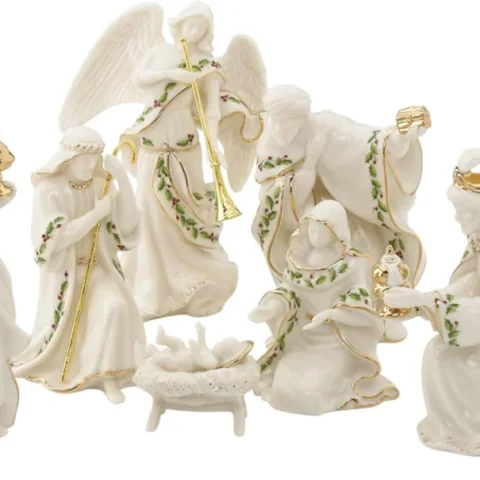
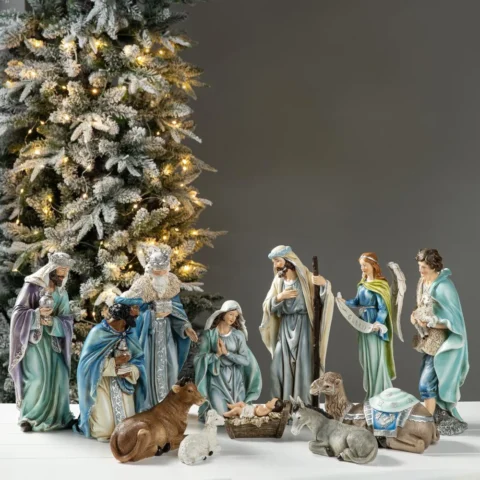
| Full set with stable | The whole cast of shepherds, kings, angel and animals, and a stable roof for the angel and the star | A sideboard or a deep mantelpiece |
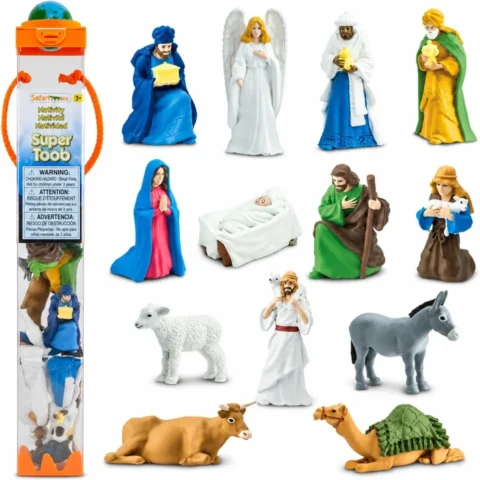
| Children’s set | Wooden, fabric or plastic figures that survive being played with | Telling the story with young children |
| Outdoor set | Weatherproof or light-up figures | A porch or front garden |
| Minimalist set | Silhouettes, plain wood or white porcelain | Modern interiors |
Our nativity sets collection gathers sets sold on Amazon UK, rated by Amazon buyers.
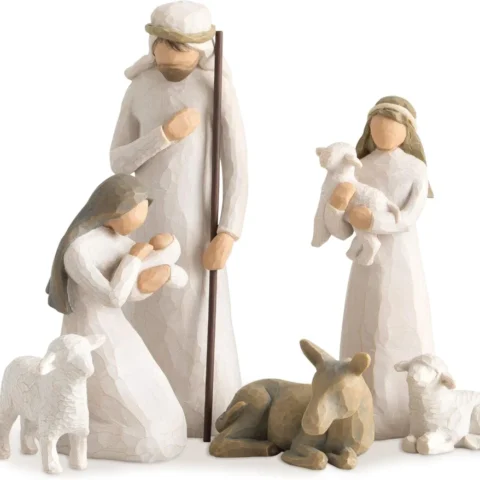
To widen the scene beyond the stable, add houses and figurines from our Christmas villages and figurines collection.
Frequently asked questions
What is the original story of the nativity?
It comes from the Gospels of Luke and Matthew. Luke tells of the census, the journey from Nazareth to Bethlehem, the birth in a manger and the shepherds visited by angels; Matthew tells of Joseph’s dream, the wise men and their star, King Herod and the escape to Egypt.
Did the nativity scene actually happen?
Christians accept the nativity as an account of Jesus’s birth, while many historians treat the details as theology rather than history. The main problems are the dates, since Herod died in 4 BC but Luke’s census was in AD 6, and the lack of any other record of Herod’s massacre.
Why is baby Jesus not in the nativity scene?
Because the birth has not happened yet. In many homes and churches the manger stays empty through Advent and the baby goes in on Christmas Eve or Christmas morning, while the wise men only arrive for the Epiphany on 6 January.
Why was 25 December chosen as Jesus’s birthday?
The Bible gives no date. 25 December first appears in a Roman calendar written in AD 336, and it is nine months after 25 March, the date of the Annunciation; it was also the winter solstice and the festival of Sol Invictus in the Roman calendar.
How many wise men were there?
Matthew does not say. Tradition settled on three because there were three gifts, and the names Caspar, Melchior and Balthazar were only added centuries later.
What is a nativity scene?
A model of the birth of Jesus, with Mary, Joseph and the baby in a manger, usually joined by shepherds, angels, the wise men and animals. In Britain it is often called the crib, and the custom goes back to Francis of Assisi’s scene at Greccio in 1223.
Were there an ox and a donkey at the nativity?
Neither Gospel mentions them. They come from a verse in the Book of Isaiah about the ox and the donkey knowing their master’s manger, and from early Christian writers such as Origen, and they have stood in nativity scenes ever since.
What figures are in a nativity set?
A full set has Mary, Joseph, the baby Jesus in a manger, an angel, shepherds with sheep, three wise men, an ox and a donkey, often with a star and a camel. Smaller sets keep only the Holy Family.