Why do we have Christmas trees? The history of the Christmas tree
From medieval paradise plays to Queen Charlotte’s tree at Windsor and the Norwegian spruce in Trafalgar Square: where the Christmas tree came from, and why we decorate it.
The Christmas tree comes from Germany and the Baltic. Guild records from Tallinn and Riga mention trees in 1441 and 1510, towns in Germany and Alsace recorded decorated trees through the 16th century, and German-born Queen Charlotte set up the first known tree in England at Windsor in December 1800. It became a British habit after 1848, when the Illustrated London News showed Queen Victoria, Prince Albert and their family round their tree at Windsor Castle. Behind it sit older customs, from evergreens brought indoors in midwinter to the paradise tree of medieval plays. Here is the history, a timeline and what each decoration meant.
Why do we have Christmas trees?
Three older ideas met in the Christmas tree:
- Evergreens in midwinter: the Romans exchanged wreaths and garlands at Kalends, their New Year festival, and tree worship was common among pagan Europeans. Scandinavians kept decorating house and barn with evergreens at the New Year after they converted, and for Christians evergreens stood for eternal life.
- The paradise tree: medieval mystery plays about Adam and Eve were performed on 24 December, their feast day. The set had a tree hung with apples, for the fruit of the tree of knowledge, and round white wafers, for the Eucharist.
- Light in the darkest weeks: legend credits Martin Luther with being the first to fix lighted candles to an evergreen, and candles stayed on trees until electric lights took over.
Christian legend adds an older origin story. Saint Boniface, the 8th-century missionary, is said to have offered a fir tree as the symbol of the true God because its leaves never die. It is a legend, not a record.
Who started the Christmas tree tradition?
No single person. The first dated trees belong to guilds and churches in the Baltic and in German-speaking towns, in the 15th and 16th centuries, and the paradise tree of the plays later moved into German homes. The custom grew up in Protestant, Lutheran Germany; the Catholic Church put up its first Christmas tree in the Vatican only in 1982.
Which country had the first Christmas tree?
Two answers are defended. The oldest dated records are Baltic: the Brotherhood of Blackheads guild set up trees in its houses in Reval, today’s Tallinn in Estonia, in 1441 and 1442, and in Riga, Latvia, in 1510, so both cities claim the first Christmas tree. The decorated tree in the family home is German, and some of its earliest records come from Alsace, now in France: a tree stood in Strasbourg Cathedral in 1539.
Who brought the Christmas tree to England?
Queen Charlotte, the German-born wife of George III, set up the first known Christmas tree in England for a children’s party at Queen’s Lodge, Windsor, in December 1800. Prince Albert gets the credit because he made it popular, 40 years later.
- 1832: Princess Victoria, then 13, writes in her diary on Christmas Eve of two trees “hung with lights and sugar ornaments”.
- 1840: English Heritage says Prince Albert is usually credited with introducing the Christmas tree into England in this year.
- 1848: the Illustrated London News prints an engraving of the royal family round their tree at Windsor Castle, and other papers pick it up.
- 1850: the American magazine Godey’s Lady’s Book copies the picture for its readers, removing the Queen’s tiara and Prince Albert’s moustache to make the family look American.
The fashion took a few years to reach ordinary homes. A report from 1858 contrasted Berlin, where every family had a tree, with Britain, where trees were still for the wealthy, and English Heritage says that by 1860 Christmas trees were very popular with the middle classes.
History of the Christmas tree: timeline
| Year | What happened |
|---|---|
| 1441 to 1442 | Trees in the Blackheads’ guild houses in Reval (Tallinn) |
| 1510 | The Blackheads set up a tree in Riga |
| 1539 | A Christmas tree stands in Strasbourg Cathedral |
| 1570 | A Bremen guild chronicle describes a tree hung with apples, nuts, dates, pretzels and paper flowers |
| 1576 | A carving on a house in Turckheim, Alsace: the earliest firmly dated image of a Christmas tree |
| 1781 | German soldiers in Quebec put up one of the first trees in North America, decorated with candles and fruit |
| 1800 | Queen Charlotte’s tree at Queen’s Lodge, Windsor |
| 1830s | Glassblowers in Lauscha, Germany, start making simple glass baubles |
| 1844 | Hans Christian Andersen publishes the fairy tale The Fir-Tree |
| 1848 | The Illustrated London News shows the royal tree at Windsor Castle |
| 1870s | Bauble making takes off in Lauscha, and glass balls are silvered on the inside |
| 1880s | Feather trees, made of green-dyed goose feathers on wire, appear in Germany |
| 1882 | Edward H. Johnson lights a tree with 80 electric bulbs in New York |
| 1933 | The first official Rockefeller Center tree in New York |
| 1947 | Oslo’s yearly gift of a tree for Trafalgar Square begins |
| 1958 | The first aluminium Christmas trees are made, in Chicago |
| 1982 | The first Christmas tree in the Vatican |
Why do we decorate Christmas trees?
Each decoration began as something real hung on the branches, often food.
| Decoration | Where it comes from |
|---|---|
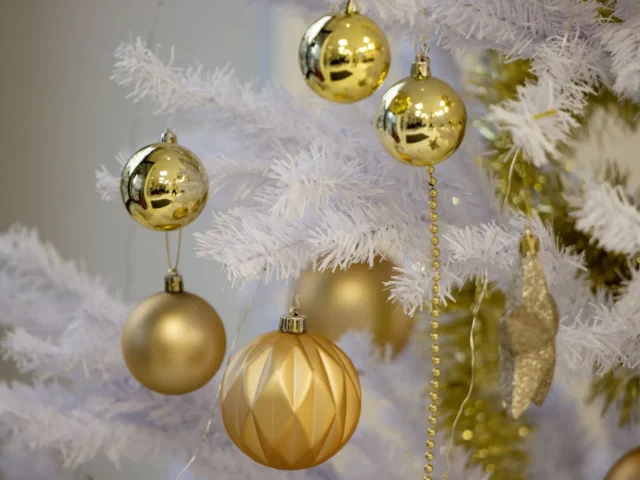
| Baubles | Apples hung on the paradise tree came first. Glassblowers in Lauscha were making simple glass balls from the 1830s, and the town’s glass museum dates the boom in its Christmas decorations to the 1870s. |
| Lights | Candles came first, with the Martin Luther legend behind them. Electric bulbs first lit a Christmas tree in 1882; Johnson’s were red, white and blue and the size of walnuts. |
| Sweets and baked treats | The wafers of the paradise tree, then the pretzels and dates of the Bremen tree and the sugar ornaments of Victoria’s childhood. |
| Paper flowers and garlands | Paper flowers already hung on the Bremen tree in 1570. |
| Star | The Star of Bethlehem, which led the Magi to Jesus. |
| Angel | The angels who announced the birth to the shepherds. |
The modern versions fill our tree decorations range. For holly, ivy, mistletoe and the rest of the season’s greenery, see our guide to traditional British Christmas decorations.
The Christmas tree in Britain today
The Norwegian tree in Trafalgar Square
Since 1947, Norway has given London a Christmas tree for Trafalgar Square every year, as thanks for British support during the Second World War. It is a Norway spruce felled in Oslomarka, the forests on the edge of Oslo, and shipped to London; the 2016 tree was 27 metres tall and 95 years old. It is switched on at a ceremony in early December, decorated in the traditional Norwegian style, and stays up until 6 January.
Which trees the British buy
The British Christmas Tree Growers Association names the Nordmann fir the most popular Christmas tree in the UK, for its needle retention. The RHS describes the Norway spruce, the traditional choice, as well scented but quick to drop its needles. The association’s 300-plus members sell about 5 million trees a year, according to a 2023 Ipsos survey it quotes.
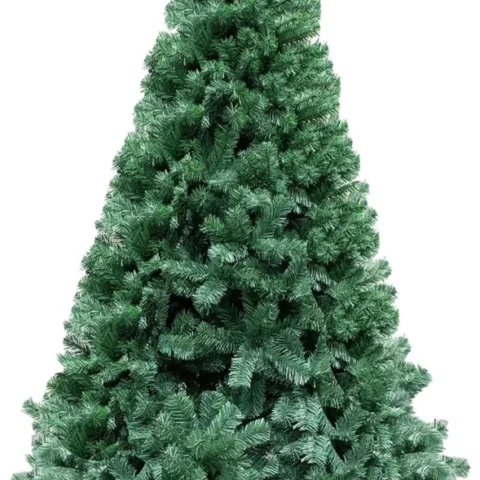
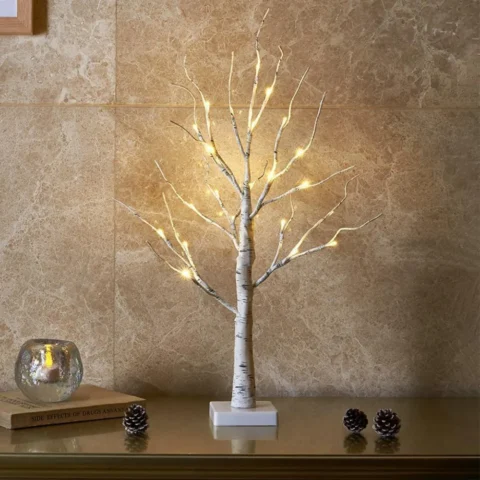
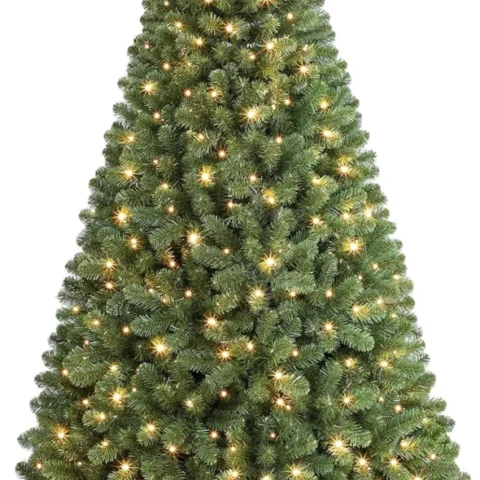
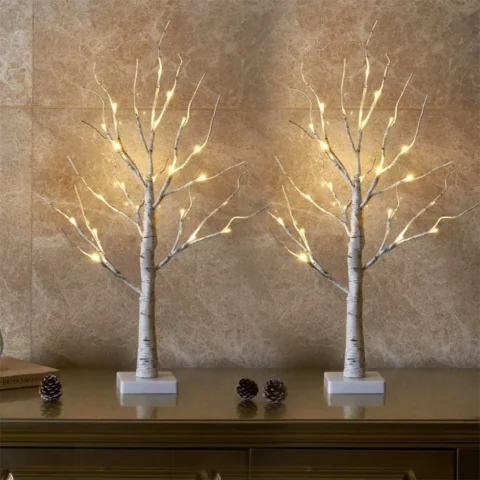
Many homes now keep an artificial tree, and every tree in our Christmas trees range is artificial, from table-top sizes to 7.5ft.
Christmas tree facts for kids and grown-ups
- Tallinn and Riga both say they had the first Christmas tree.
- Before plastic, Germans made artificial trees from goose feathers dyed green.
- The popular story that the brush maker Addis invented the bristle tree in 1930 does not hold up: the Hagley Museum and Library found that bristle trees came from brush-making machines developed in New York in the 1950s.
- The earliest American patent for an artificial Christmas tree that the Hagley Museum and Library found went to August Wengenroth of Troy, New York, in 1882.
- The first Rockefeller Center tree, in 1931, was a 20ft (6 m) balsam fir that construction workers decorated with cranberries, paper garlands and tin cans.
- The Swarovski star made for the Rockefeller Center tree in 2018 carries three million crystals and weighs about 408 kg.
- The first electric lights on a White House family tree were used in 1894, under President Grover Cleveland, according to the White House Historical Association.
- In the 1880s the American shopkeeper F. W. Woolworth began importing German glass baubles to the United States.
- In 1935 the Soviet Union, which had banned Christmas trees, brought back the decorated spruce as a New Year tree.
If you are planning this year’s tree, our guide to when to put up a Christmas tree covers the dates, and the full artificial Christmas tree range lists every height.
Frequently asked questions
What is the true story behind the Christmas tree?
It grew from older customs: evergreens brought indoors in midwinter and the paradise tree, hung with apples and wafers, in medieval plays about Adam and Eve on 24 December. Guilds in Tallinn and Riga set up trees in the 15th and 16th centuries, and German families made the decorated tree a home custom.
Who brought the Christmas tree to England?
Queen Charlotte, the German-born wife of George III, had the first known English tree at Windsor in December 1800. Prince Albert made it fashionable in the 1840s, helped by an 1848 engraving of the royal family’s tree in the Illustrated London News.
Which country was the first to decorate a Christmas tree?
Germany is usually credited with the decorated family tree, and some of the earliest records come from Alsace and Bremen in the 16th century. Estonia and Latvia have older dated records, from guild houses in Tallinn in 1441 and Riga in 1510.
Which country gives the UK a Christmas tree every year?
Norway. A Norway spruce from the forest around Oslo goes to Trafalgar Square each year as thanks for British help during the Second World War, a tradition that began in 1947. It is switched on at a ceremony in early December and stays up until 6 January.
Where is the most famous Christmas tree in the world?
The best-known candidate is the Rockefeller Center tree in New York, an official tradition since 1933 and usually a Norway spruce of 21 to 30 metres. In Britain, the best known is the Norwegian tree in Trafalgar Square.
What is the most popular Christmas tree in the UK?
The Nordmann fir, according to the British Christmas Tree Growers Association, because it holds its needles well. The Norway spruce is the traditional alternative, with a good scent but faster needle drop, as the RHS notes.
Why do we decorate Christmas trees?
The first decorations were food with a meaning: apples for the fruit of paradise and wafers for the Eucharist, with candles added later, a custom legend traces to Martin Luther. Glass baubles and electric bulbs later took their place.