How to hang outdoor Christmas lights safely, with or without gutters
Where to start, how many clips to buy, what holds on gutters, fascias and brick, and how to get power to the lights safely.
To hang outdoor Christmas lights safely, test them at ground level, plan the run backwards from the socket and fix the cable with clips or hooks, never nails. Use lights made for outdoor use, protect the circuit with an RCD and climb a ladder set at the right angle with someone footing it. Below are the clip counts, the fixings for gutters, fascias and brick, and the power options, in the order you need them.
What you need to hang outdoor Christmas lights
Gather the kit before you climb, so each section of the house takes one trip up the ladder.
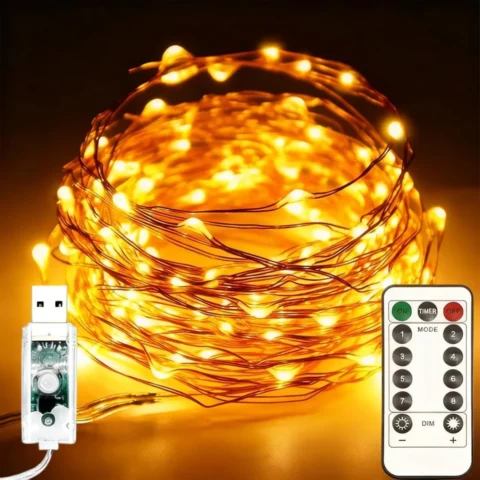
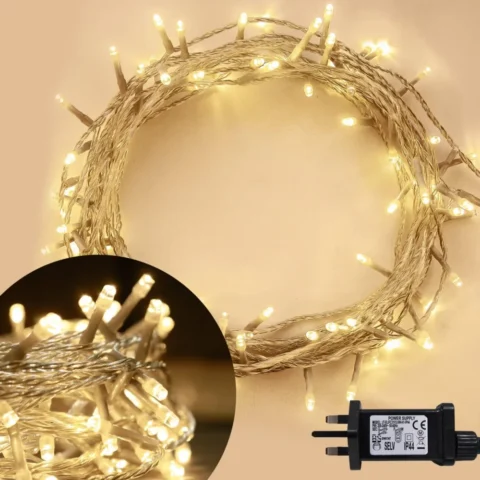
- Lights sold for outdoor use. Electrical Safety First says they should carry a water drop symbol or an IP code whose last digit, which covers water, is 3 or higher. Our Christmas lights range mixes indoor and outdoor sets, so check the label before you choose.
- Fixings that suit the surface: gutter hooks, adhesive clips for uPVC or painted wood, brick clips or screw hooks for masonry, cable ties for railings.
- A tape measure, to size the run before you buy.
- A ladder on firm, level ground and a second person to foot it.
- Power: a socket indoors or an outdoor socket with a weatherproof cover, an extension lead made for outdoor use if the cable falls short, and an RCD plug if the circuit has no RCD.
- A plug-in timer, unless the lights have one built in.
Before you climb: test, measure and plan from the socket
- Plug the lights in on the ground and check that every bulb works. Swapping a faulty set on the lawn takes a minute; on the gutter it means unclipping the whole run.
- Look along the cable for cuts, crushed sections and loose connectors. A damaged set stays indoors.
- Measure the run you want to light: gutter, fascia, fence or hedge.
- Measure from the socket to the point where the first bulb should sit, and compare it with the lead cable, the unlit length between the plug or transformer and the first bulb. If it falls short, plan an outdoor extension lead rather than stretching the cable.
- Plan to start at the socket and work away from it, so the cable always reaches the power without strain.
How many clips you need
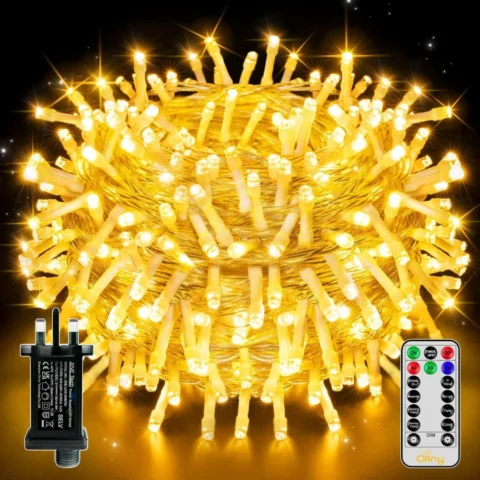
Spacing depends on the size of the bulbs. The UK lighting maker Festive Lights advises a gutter hook every 50 cm for small bulbs and every 30 cm for big ones: divide the length of the lit cable by the spacing and round up.
| Length of lit cable | Small bulbs such as fairy lights (clip every 50 cm) | Big bulbs, icicles or heavier sets (clip every 30 cm) |
|---|---|---|
| 5 m | 10 clips | 17 clips |
| 10 m | 20 clips | 34 clips |
| 12 m | 24 clips | 40 clips |
| 15 m | 30 clips | 50 clips |
| 20 m | 40 clips | 67 clips |
| 25 m | 50 clips | 84 clips |
Buy a few more than the table says, so one hook dropped from the ladder does not stop the job.
How to hang Christmas lights on a house, step by step
- Pick a dry day. Electrical Safety First advises against using electrical equipment outdoors until things are dry, even if there is only dew on the ground.
- Fit all the clips or hooks along the run first, at the spacing above, starting at the socket end.
- Lay the lights into the clips from the socket outwards. Leave the cable slightly slack between fixings, with no tension at the connectors and no loops hanging down.
- Join extra sets only if the instructions say they connect, and stay within the number of sets they allow. Electrical Safety First warns against connecting different lighting sets together.
- Run the lead down to the socket along walls and edges, and fix it so nobody can trip on it.
- Switch on, walk to the pavement and check the spacing and any sag before the ladder goes away.
- Set the timer to switch on at dusk and off at bedtime, and unplug at the socket overnight and when you go out, as Electrical Safety First advises for Christmas lights.
How to hang Christmas lights on gutters
On most British houses the gutter is the easiest fixing. A gutter hook clips over the front lip and holds the cable, with no drilling and nothing stuck to the paintwork, and it lifts off in January.
- Check that the gutters are clean and firmly fixed before you hang anything from them.
- Use clips made for Christmas lights rather than makeshift fixings, and never nail or staple through the cable. Festive Lights warns that holes in a gutter can lead to leaks.
- Keep the gutter load light. Heavy cabled lights are better on the lawn, trees, hedges and fences.
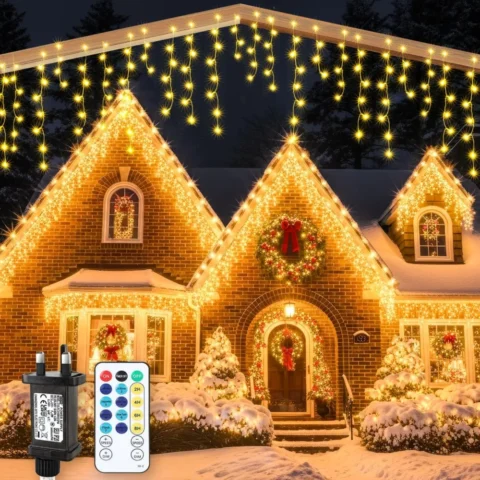
- Icicle lights hang from the gutter line and their drops add weight, so use the 30 cm spacing.
How to hang Christmas lights with no gutter
A house without gutters, or with gutters you would rather not load, still has fixing points, and none of them needs nails. Match the fixing to the surface.
Fascia boards and window frames
Adhesive-backed clips stick to smooth wood and uPVC, which covers fascias, door frames and window frames. Clean and dry the surface before you press each clip on. Lights hung inside the glass need no outdoor fixings at all: see our Christmas window lights for curtain and silhouette styles.
Brick walls, with and without drilling
- Drilling: drill into the mortar joints, not the bricks, which Festive Lights warns can crack, then tap in wall plugs and screw in the hooks.
- Brick clips: spring clips that grip a brick standing proud of the mortar. Family Handyman notes that they do not work where brick and mortar are flush or nearly flush.
- Hot glue: a dab on the light clip, held against the brick for 10 to 20 seconds. According to Family Handyman it peels off without a mark, and rubbing alcohol shifts any residue.
- Outdoor mounting tape: best on smoother masonry, and it can lift paint when you remove it.
Trees, hedges, railings and pillars
Net lights drape over a hedge with no fixings, and cable ties hold string lights to railings and fence tops. For a tree trunk or a porch pillar, wrap the lights in a spiral from the bottom. To size the set, divide the height to wrap by the gap between turns to get the number of turns, then multiply by the length of one turn, which is a little more than the circumference because each turn also climbs.
| Circumference of trunk or pillar | Turns 20 cm apart | Turns 15 cm apart | Turns 10 cm apart |
|---|---|---|---|
| 30 cm | 3.6 m | 4.5 m | 6.3 m |
| 60 cm | 6.3 m | 8.2 m | 12.2 m |
| 90 cm | 9.2 m | 12.2 m | 18.1 m |
| 120 cm | 12.2 m | 16.1 m | 24.1 m |
The figures cover 2 m of height; add the distance from the socket to the base. For a lit display with no fixings on the house at all, light-up reindeer and outdoor figures stand on the lawn, pegged down against the wind; most plug into the mains, so include them in your power plan.
How to get power to outdoor Christmas lights
The power source decides where the lights can go, so settle it before you buy.
| Option | How it works | What to check |
|---|---|---|
| Indoor socket | The plug and transformer stay inside, as Electrical Safety First advises even for outdoor lights, and the cable runs out to the display | RCD protection, and a lead cable long enough to reach |
| Outdoor socket | Fitted to an outside wall by a registered electrician, with a weatherproof cover | A 30 mA RCD: Electrical Safety First says any lights plugged in outdoors must have one |
| Outdoor extension lead | Runs from an indoor socket to the display | Made for outdoor use, weather-resistant, with moulded connections |
| Battery or solar | A power pack at the lights, no socket needed | Run time on short December days |
Battery and solar sets free you from cables but give fewer hours in December: our guide to solar and battery Christmas lights compares them in a British winter.
RCDs, transformers and the window gap
- Electrical Safety First says to use an RCD with all outdoor electrical equipment. If your consumer unit has none, fit an RCD plug at the socket.
- Most LED Christmas lights run at extra-low voltage through a transformer, which Electrical Safety First calls the safest type. The charity advises keeping the plug and the transformer indoors, even when the lights are made for outdoor use.
- Plan how the cable gets outside. Festive Lights notes that the thin cable of its 31 V sets passes through uPVC doors and windows that still close, which thicker mains cable does not allow.
- Extension leads are rated at 13 A (some older ones at 10 A). Use one lead per wall socket and never plug one extension lead into another.
- Unwind a cable reel fully before use: Electrical Safety First warns that a reel run while wound can overheat and catch fire.
What the IP rating means
| Rating | Protection against water | Use it for |
|---|---|---|
| IP20 | None | Indoors only |
| IPX3 (last digit 3) | Spray up to 60 degrees from vertical | The minimum for outdoor lights, according to Electrical Safety First |
| IP44 | Splashing water from any direction | Outdoor lights, with a margin over that minimum |
| IP65 | Water jets from any direction, and dust-tight | Exposed walls and lights left up for longer |
| IP67 | Short immersion, up to 1 m deep | Lights at ground level where puddles form |
Ladder safety when hanging Christmas lights outside
The HSE’s rules for ladders are written for workplaces, and they suit a front gutter in December just as well.
- Set a leaning ladder at 75 degrees: one unit out at the foot for every four units up.
- Extend it at least 1 m, or three rungs, above the point where you work, and do not work off the top three rungs.
- Keep three points of contact, two feet and one hand.
- On a stepladder, do not stand on the top three steps unless there is a handhold.
- Move the ladder rather than leaning out to reach the next clip: the HSE says to keep your belt buckle within the stiles.
- The HSE recommends other equipment for any task that keeps you on a ladder for more than 30 minutes at a time.
- Keep clear of overhead power lines: the HSE says not to work within 6 m horizontally of one unless it has been made dead or insulated.
Photograph the finished run from the pavement and note how many clips each section took. Next year you can buy the right number and fit them in the same places.
Compare the IP rating and the length of the lead cable on the sets in our outdoor Christmas lights collection before you fix the layout.
Most Christmas inflatables stay up on a built-in mains fan, so count them in your socket plan alongside the lights. Indoor sets, fairy lights and tree lights are in the full Christmas lights collection.
Frequently asked questions
Can you hang outdoor Christmas lights inside?
Yes. Lights sold for outdoor use work indoors, since their weatherproofing does no harm inside. The reverse is the problem: indoor sets are not sealed against rain and frost, so keep them inside.
What is the easiest way to hang Christmas lights outside?
Gutter hooks are the quickest on most houses: they clip over the gutter lip and hold the cable without drilling or glue. Net lights thrown over a hedge are easier still, as they need no fixings at all.
How do you hang Christmas lights when there is no gutter?
Stick adhesive light clips to the fascia board or the window and door frames, which works on clean uPVC and painted wood. On brick, use brick clips where the bricks stand proud of the mortar, or screw hooks in drilled mortar joints.
How do I attach outdoor lights to a brick wall without drilling?
Brick clips grip the edges of bricks that sit proud of the mortar, so they fail on flush brickwork. Otherwise, a dab of hot glue on each light clip holds on rough brick and peels off in January, and outdoor mounting tape suits smoother masonry but can lift paint.
How do I get power to my outdoor Christmas lights?
Electrical Safety First advises plugging the plug and transformer in indoors, even for outdoor lights, on a circuit with RCD protection or through an RCD plug. Any lights plugged into an outdoor socket must have a 30 mA RCD. An extension lead must be made for outdoor use, or choose battery or solar lights that need no socket.
How can I hang string lights outside without an outlet?
Choose battery or solar sets. Battery packs work anywhere, including shade, while a solar panel needs some direct sun each day, which is scarce in December. A timer on either type stretches the run time.
What do I need to hang outdoor string lights?
Lights made for outdoor use, with an IP code whose last digit is 3 or higher, fixings for each surface, a tape measure, a stable ladder with a helper, a power source with RCD protection and a timer. Count the clips before you start: length of cable divided by the spacing.
How far apart should Christmas light clips be?
The UK lighting maker Festive Lights advises about 50 cm apart for small bulbs and 30 cm for big bulbs. Use the closer spacing for icicle lights too, as the drops add weight. A 10 m run therefore takes 20 clips at 50 cm and 34 at 30 cm.