How to fold Christmas napkins: 5 easy folds, step by step
The Christmas tree fold takes about two minutes once you know where the layers go. Here it is step by step, with four easier folds and the napkin size, fabric and starch that make them hold.
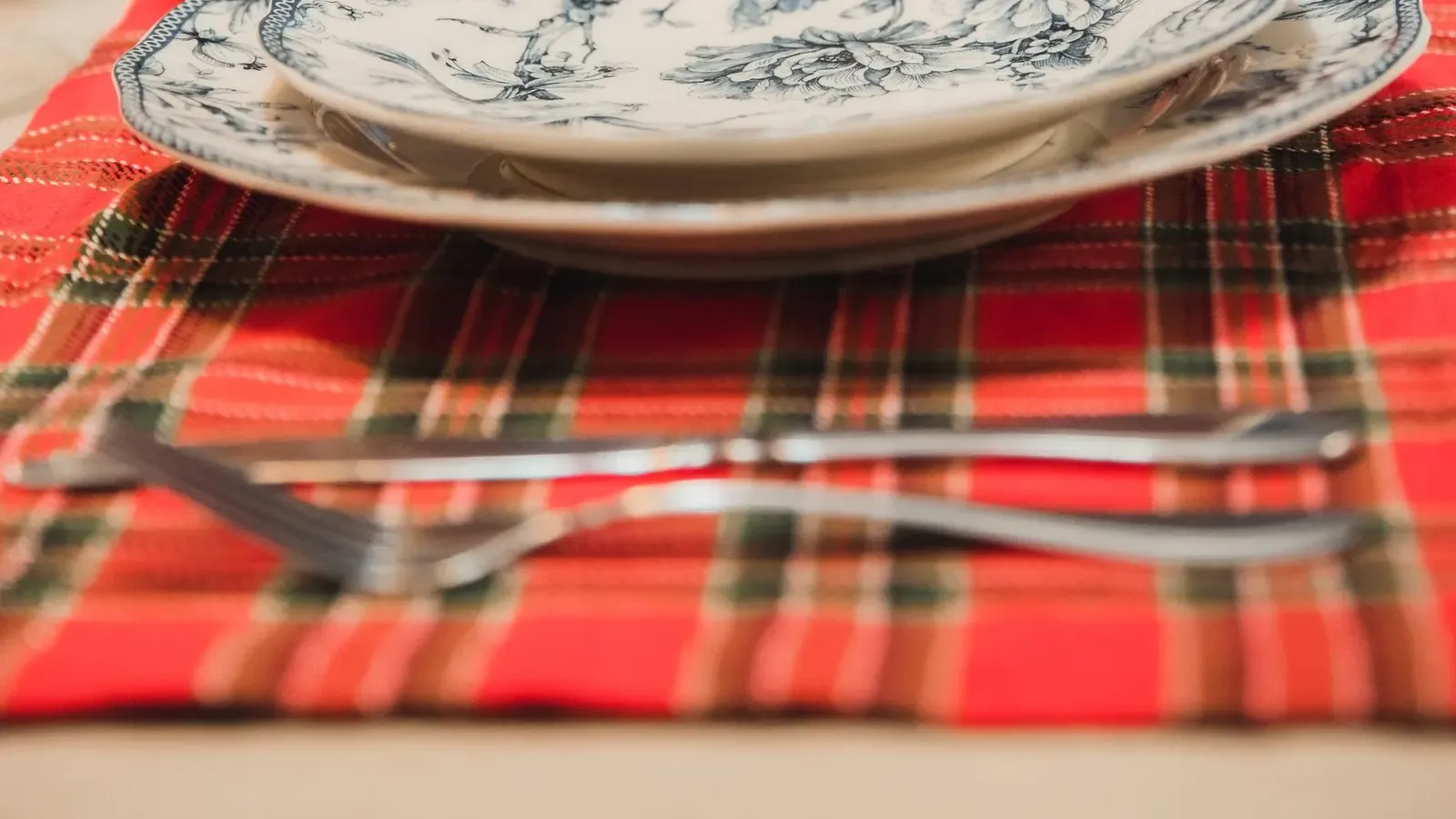
A folded napkin is the quickest way to make a Christmas table look finished, and five folds cover every kind of meal. The Christmas tree is the one most people look for. The poinsettia and the candle add colour, the napkin ring bow needs almost no folding, and the cutlery pocket keeps a buffet tidy. Every fold below starts from a square napkin laid flat.
Christmas napkin folds at a glance
| Fold | Best napkin | Difficulty | Where it goes |
|---|---|---|---|
| Christmas tree | Green cloth, dinner size | Moderate, about 2 minutes | Flat on the plate |
| Poinsettia | Red cloth or 3-ply paper | Easy | Middle of the plate |
| Candle | Red, white or gold, any size | Easy | Standing on the plate |
| Napkin ring bow | Light cloth or paper, plus a napkin ring | Easy | Across the plate |
| Cutlery pocket | Cloth or paper | Easy, under a minute | On the plate or to its left, with the knife and fork inside |
Difficulty is our own rating. Laying a long table in a hurry? Use the bow or the pocket.
Which napkins fold best
Cloth napkins give the crispest shapes. Cotton and linen are the easiest to work, and a poly-cotton blend folds just as well. Size matters most for the tree: use the largest square dinner napkin you have, because a bigger square gives a taller tree with more room between the layers.
- 43 cmsquare folds to about 15 cm for a poinsettia
- About 1 cmgap between the layers of the tree
- 3-plypaper napkins, if you fold paper
Wash, starch and iron cloth napkins before you fold them. Starch sharpens every crease and helps the napkin resist stains, and silky or fine fabrics need it most, or the petals and branches droop. Paper napkins hold a crease better than cloth: choose 3-ply and fold with clean, dry hands.
How to fold a napkin into a Christmas tree
The Christmas tree napkin fold gives a flat, layered tree that lies on the plate. Green looks the most like a tree, but a white napkin on a green or tartan tablecloth works too.
- Fold the napkin in half, then in half again, to make a smaller square.
- Turn the square into a diamond with all the loose corners at the bottom, pointing towards you.
- Fold the top layer’s corner up towards the top point, stopping just short of it. Fold the next layer up so its corner sits about 1 cm below the first, and carry on until every layer is folded. The edges should step down evenly.
- Slide one hand under the napkin, hold it flat between both hands and turn it over.
- Fold the left corner across to the right-hand edge, then the right corner across to the left-hand edge, so the napkin becomes a long, narrow triangle.
- Turn the napkin back over so the stepped layers face you.
- Starting at the top, fold each layer up. From the second layer down, tuck each point under the layer above so it disappears. Each tuck makes one tier of branches.
- Turn the tree so its point is at the top and lay it on the plate.
Getting the branches even
The spacing in step 3 decides how the finished tree looks. Keep the gaps equal and smooth each layer flat before you fold the next. If the tiers come out uneven, unfold back to step 3 rather than adjusting the tucks, because every tuck depends on those first steps.
Finish each tree with a small paper star or a name card at the tip. It doubles as a place card, so nobody has to ask which seat is theirs.
Poinsettia napkin fold
The poinsettia is the classic rose fold made with a red napkin: three rounds of corners folded into the centre, then the corners pulled out as petals. It looks complicated but works with almost any napkin, paper included.
- Lay the napkin face down and fold all four corners into the centre so their points meet.
- Fold the four new corners into the centre again.
- Turn the napkin over. A plate held on top stops the folds springing open while you flip it.
- Fold the four corners into the centre a third time.
- Press the centre down with your fingertips or the base of a glass. Reach under one corner and pull the flap underneath outwards to make a petal, then do the same at the other three corners.
- For a fuller flower, reach under the middle of each side and pull out a second set of four petals.
Each round of folds shrinks the square. A 43 cm (17 in) napkin ends up about 15 cm across before the petals open, a good size for the middle of a dinner plate.
Candle napkin fold
A rolled candle stands upright on the plate and needs no starch. Use a red napkin for the classic look, or a white or gold one on a red tablecloth.
- Lay the napkin face down and fold it in half diagonally into a triangle.
- Turn it so the long folded edge is nearest you and the point faces away.
- Fold the long edge up by about 2.5 cm (1 in) and press it down hard, or it will get in the way when you roll.
- Starting at one end, roll the napkin into a tight cylinder. Keep the bottom edge straight so the candle stands up.
- Tuck the loose end into the folded band at the back and stand the candle on the plate.
Napkin ring bow
The napkin ring does most of the work here, so this is the fold for a long table and little time. Cocktail or luncheon-size napkins suit it best.
- Lay the napkin face down. Fold it backwards and forwards in pleats 2 to 3 cm deep, like a paper fan, until it is a long pleated strip.
- Pinch the strip in the middle and slide a napkin ring over it, or tie it with a length of ribbon.
- Spread the pleats at both ends into a bow and lay it across the plate.
For a fan instead, crease the napkin across the middle, pleat it, fold the pleated strip in half and push the folded end into the ring so the pleats open upwards. If you tie it with ribbon instead of a ring, our guide on how to tie a bow with ribbon shows the knot.
Cutlery pocket fold
This fold, also called the diagonal pocket, holds a knife, a fork and a name card. It keeps a buffet or a crowded table tidy and takes under a minute.
- Lay the napkin face down, fold it in half and then into quarters.
- Turn it so the loose corners point away from you and to the left.
- Fold the top layer in half diagonally and press it flat. This band is the front of the pocket.
- Turn the napkin over so the loose corners point away from you and to the right.
- Fold the right side back by about a third and press, then fold the left side back by a third and press.
- Turn it back over and slide the cutlery into the pocket.
Where to put a folded napkin
Debrett’s, the British etiquette guide, puts the napkin on the side plate, simply folded or rolled. Shaped folds such as the tree, the poinsettia and the candle are made to be seen, so set them in the middle of the dinner plate instead, and at a relaxed meal a napkin can stand in the wine glass.
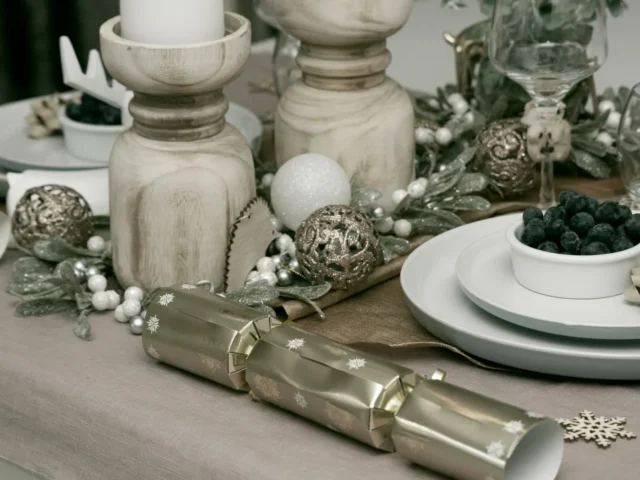
Plain white plates make any fold stand out; for patterned ones, see our Christmas plates and tableware. Our guide to Christmas table setting ideas covers where the cutlery, glasses and crackers go, and crackers, runners and centrepieces are in our Christmas table decorations collection.
Folding Christmas napkins ahead of the day
All five folds can be done before Christmas Day, which frees the morning for the cooking.
- Fold the day before and store the napkins flat in a covered box, away from steam and pets.
- Take the poinsettia as far as step 4 several days ahead and stack the napkins between plates. The plates can leave faint marks, which vanish once the petals are pulled out.
- Count one napkin per guest plus a spare or two for spills, and a few small napkins per guest if you serve drinks and nibbles first.
- Set the folded napkins out last, after the cloth and the cutlery, so they do not get squashed.
A plain cloth shows the shapes best: a green tree on white or cream, a red poinsettia on green. For a backdrop, browse our Christmas tablecloths, and for everything else on the table, the full range of table decorations.
Frequently asked questions
How do you fold a napkin into a Christmas tree?
Fold a square napkin into quarters, set it as a diamond with the loose corners towards you and fold each layer up, each one about 1 cm short of the last. Turn it over, fold the two sides across to make a narrow triangle, turn it back and tuck each layer under the one above to form the branches. Expect about two minutes per napkin once you have done one.
What size napkin is best for folding?
For the Christmas tree, use the biggest square dinner napkin you own: the larger the square, the taller the tree and the wider the gaps between its layers. The poinsettia, candle and cutlery pocket work with almost any square napkin. Small cocktail napkins are best kept for drinks or a napkin ring bow.
What are the basic napkin folds?
There is no official list of five, seven or ten. Common folds include the bishop’s hat, fan, candle, rose, lotus, fleur-de-lis, envelope, dress shirt and two pockets, the rectangular buffet fold and the diagonal pocket. Folding napkins into shapes is an old craft: the earliest known printed instructions appeared in Padua in 1639.
How do you fold napkins for dinner guests easily?
Pick one quick fold and do the whole set the day before. The cutlery pocket takes under a minute, and a napkin ring bow needs almost no folding at all. Store the folded napkins flat in a covered box until you lay the table.
How do you fold a napkin the French way?
The French fold drapes across the plate. Fold the napkin in half diagonally, turn it so the long side is on the left, then fold the far corner towards you and to the right so the crease stops 2.5 to 5 cm short of the right-hand point. Fold that right-hand point towards you, pivoting at the same spot.
What are some funny napkin folding ideas for Christmas?
A red napkin makes a Santa hat: fold it into a triangle, roll the long edge up into a brim and tuck the tip under, then add a white paper circle as the bobble. Elf hats and elf shoes are rolled and tucked in a similar way and go down well on a children’s table.
Can you fold paper napkins for Christmas?
Yes. Choose 3-ply paper napkins, which hold a crease better than cloth, and fold with clean, dry hands. The poinsettia, candle and pocket all work in paper; the Christmas tree needs a large square, so use the biggest dinner size you can find.