Best artificial Christmas trees in the UK: what to look for
The best artificial Christmas tree is the one whose numbers fit your room and your plans: height, width, PE share, tip count and warranty. Here is how to read them, with London Fire Brigade’s safety advice and the Carbon Trust’s carbon sums.
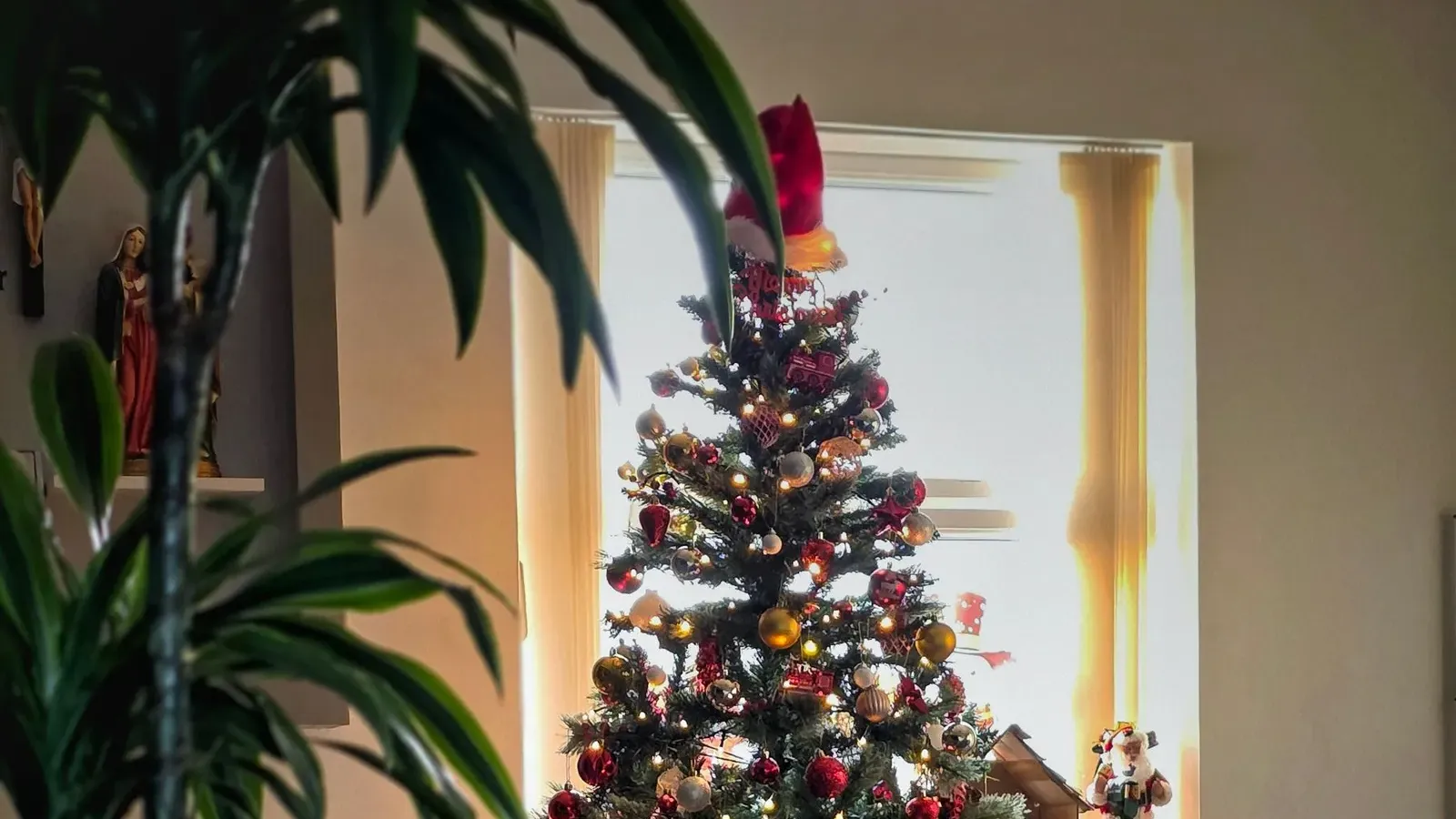
The best artificial Christmas tree for most UK homes is a hinged tree with moulded PE tips on the outside, a metal stand and a height that leaves room for the topper below the ceiling. The brand matters less than the numbers on the listing: height in centimetres, width, tip count and the share of PE tips. This guide explains each one and covers branch types, pre-lit trees, lifespan and the carbon sums against a real tree.
How to choose the best artificial Christmas tree: the checklist
Work through these points in order. The first two decide whether the tree fits the room; the rest decide how real it looks and how long it lasts.
- Height: measure floor to ceiling, then take off the height of your topper and a small gap. Check the height in centimetres on the listing rather than the size in feet.
- Width: check the width in centimetres against your floor space, leaving room to walk past.
- Foliage: moulded PE tips look most like real needles, while flat PVC tips fill the tree out for less.
- Tip count: compare it only between trees of the same height and width.
- Branches: hinged branches fold down from the pole; hook-on branches go in one by one.
- Stand: check what comes in the box. If the stand wobbles, one of our Christmas tree stands can replace it.
- Fire safety: London Fire Brigade advises checking the packaging for a fire-retardant or fire-resistant label.
- Warranty: compare its length in years, and on a pre-lit tree check that it covers the lights.
Ceiling height and tree size
The space left above the tree has to take your topper plus a small gap, so measure the topper before you choose. Heights in feet are converted to metres.
| Ceiling height | Size to look for | Space left above the tree |
|---|---|---|
| 2.2 m | 6ft (1.83 m) | 37 cm |
| 2.4 m | 6ft or 6.5ft (1.98 m) | 57 cm or 42 cm |
| 2.5 m | 7ft (2.13 m) | 37 cm |
| 2.7 m | 7.5ft (2.29 m) | 41 cm |
| 3.0 m | 8ft (2.44 m) | 56 cm |
What makes an artificial Christmas tree look realistic
Realism comes down to the needles. PVC tips are made from flat PVC film: full and bushy from across the room, visibly flat up close. PE (polyethylene) tips are moulded, and some makers take the moulds from real branches, so each tip is three-dimensional. On a mixed tree, the PE tips do most for the look on the outside of the branches, where you see them.
Check the PE share on a “PE/PVC” tree
A tree sold as PE/PVC can be mostly PVC. When a listing gives the split, divide the number of PE tips by the total: 600 PE tips out of 1,500, for example, makes a tree 40% PE and 60% PVC. A higher PE share means a more lifelike tree. Branch tips of different lengths and shapes also look more natural than rows of identical ones.
Hinged, hook-on or pop-up branches
The branch system decides how long the tree takes to put up every year.
| Type | How it works | Set-up |
|---|---|---|
| Hinged | Branches stay attached to the pole and fold down into place | Slot the sections together, then fluff |
| Hook-on | Each branch hooks into the pole, usually colour-coded by row | Slowest: every branch has to be sorted and fitted |
| Pop-up | The tree collapses for storage and opens out in one piece | Fastest, with little or no assembly |
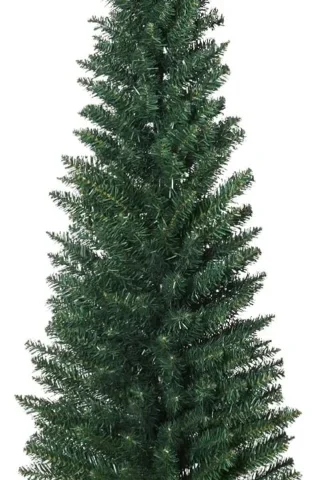
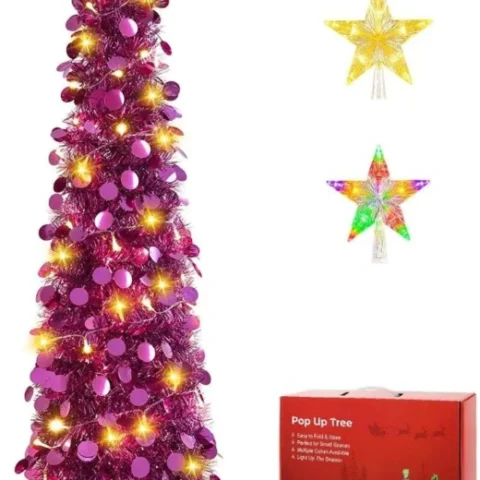
If set-up time is the priority, look at our pop-up Christmas trees; for a narrow hallway or a flat, the slim and pencil Christmas trees take a fraction of the floor space of a full shape.
Fluffing: how to make a tree look full
Even a hinged tree arrives with its branches pressed flat from the box. Fluffing them is what turns a sparse-looking tree into a full one:
- Put up the bottom section alone and fluff it before adding the next, while you can still reach the inner branches.
- On each branch, start at the pole and work outwards, separating the tips and spreading them left, right and slightly upwards like a fan.
- Leave no tip lying flat against its neighbour: that is where the gaps show.
- Wear gardening gloves, as stiff PVC tips are hard on the hands.
- Step back and check the tree from where people will see it, then fill any gaps from the inside.
Pre-lit or unlit?
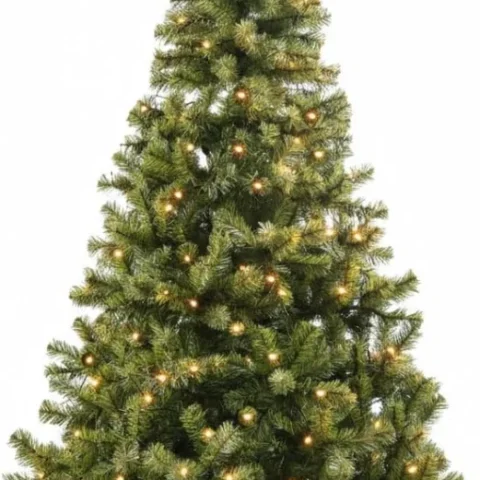
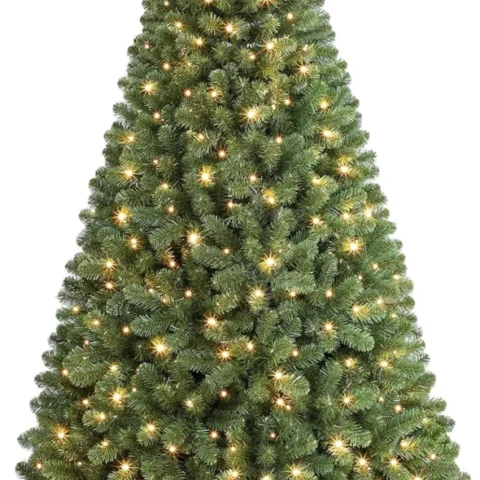
A pre-lit tree has its lights wired along the branches, so there is nothing to wrap each year. Look for the number of LEDs on the listing: whether it is enough depends on how bright you like the tree, and our chart of how many lights a Christmas tree needs gives counts by height.
- For: no stringing, lights spread evenly through the branches, and LEDs stay cooler than old incandescent bulbs.
- Against: changing the colour or style of the lights later means adding more sets on top.
- Check: lights from a reputable seller with a CE or UKCA safety mark, as London Fire Brigade advises.
- Use: switch them off when you go to bed or go out, and put them on a timer if you might forget, as London Fire Brigade suggests.
Compare the LED count and the light colour across our pre-lit Christmas trees before you choose.
How long does an artificial Christmas tree last?
The warranty is the best guide to the maker’s own expectations, so compare its length in years between trees. London Fire Brigade notes that modern artificial trees are usually fire retardant or resistant, and says it may be time to consider replacing an older one.
The carbon sums against a real tree
Carbon Trust figures quoted by Recycle Devon put a 2 m artificial tree at around 40 kg of CO2 equivalent: more than twice a 2 m real tree that ends up in landfill, at 16 kg, and more than ten times a real tree burnt on a bonfire. The Carbon Trust adds that having a real tree chipped to spread on the garden cuts its footprint by up to 80%.
The Carbon Trust’s advice is that an artificial tree used for 7 to 20 years, depending on its weight and materials, is better for emissions than buying a new commercially grown tree every year. The longer you keep it, the lower its footprint per Christmas.
Keep the carton or a tree bag and store the tree flat in a dry place. On the 40 kg figure, a tree kept 12 years instead of 5 cuts its carbon cost per Christmas from 8 kg to about 3.3 kg.
When to buy, and how much to spend
October and November give the widest choice of heights, shapes and pre-lit options. The January sales cost less, but you will need dry storage for the eleven months before you use it.
- Work out the cost per Christmas: divide the price by the number of years you expect to use the tree.
- Spend on what decides lifespan: hinged branches, a metal stand, a high PE share and a long warranty.
- Save on what you can add later: lights, a topper and a skirt.
Which artificial tree suits your room?
| Your room | Shape to choose |
|---|---|
| Living room with space | Full 6 to 7ft tree, hinged, PE and PVC |
| Hallway, flat or narrow corner | Slim or pencil tree |
| Little time to set up | Pop-up tree |
| No time to wrap lights | Pre-lit tree with warm white LEDs |
| Ceiling of 2.7 m or more | 7.5 to 8ft full tree on a sturdy stand |
Once you have the height and shape, compare the PE share and warranty across our artificial Christmas trees.
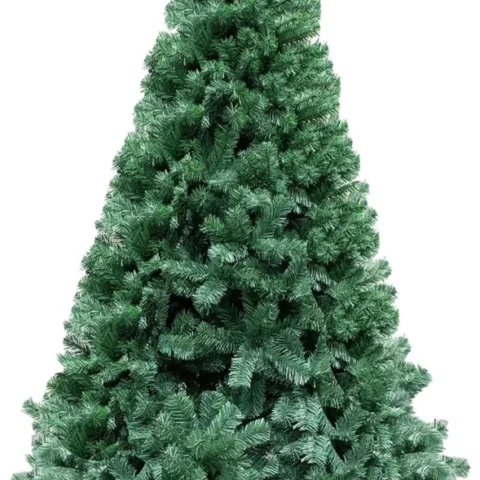
Check the height of any tree in the Christmas trees collection against your ceiling before you add it to your basket.
Frequently asked questions
Which type of artificial Christmas tree is best?
For most homes, a hinged tree with PE tips on the outside and PVC filler inside, on a metal stand. Hinged branches cut the set-up time, PE tips give the realistic look, and the PVC keeps the tree full at a lower cost.
Which artificial Christmas tree is the most realistic?
The one with the highest share of PE tips. PE is moulded into three-dimensional tips, some makers using moulds taken from real branches, while PVC tips are made from flat film. Varied tip lengths and a natural, slightly uneven outline help too.
What should I look for when buying an artificial Christmas tree?
Height in centimetres against your ceiling, width against your floor space, the PE share and a tip count compared at equal size. Then check for hinged branches, a metal stand, a fire-retardant label and the length of the warranty.
How many years should an artificial Christmas tree last?
Long enough to beat a real tree on carbon: the Carbon Trust puts that at 7 to 20 years of use, depending on the tree’s weight and materials. The length of the warranty is a fair sign of how long the maker expects the tree to last, so compare it between trees.
What is the best time to buy an artificial Christmas tree?
October and November give the widest choice of heights, shapes and pre-lit options. The January sales are cheaper, but the tree then has to wait eleven months in dry storage.
How much should you spend on a fake Christmas tree?
Think per Christmas: divide the price by the years you will use it. A dearer hinged PE and PVC tree kept for twelve years can cost less per year than a cheap all-PVC tree replaced after three.
Are artificial Christmas trees better for the environment than real ones?
Only if you keep them for years. Carbon Trust figures quoted by Recycle Devon put a 2 m artificial tree at around 40 kg of CO2 equivalent, more than twice the 16 kg of a 2 m real tree sent to landfill. The Carbon Trust says an artificial tree needs 7 to 20 years of use, depending on its weight and materials, to do better than buying a new tree every year.
Are pre-lit artificial Christmas trees worth it?
They save the yearly job of wrapping lights and spread the bulbs evenly, which suits anyone who keeps the same look every year. The trade-off is flexibility, so choose warm white LEDs with a CE or UKCA mark and check the warranty covers the lights.