How to make Christmas cards at home: 10 easy handmade designs
Ten handmade Christmas card designs, from a washi tape tree to a pop-up card, plus the card weights, envelope sizes and postage limits that decide how a homemade card travels.

A handmade Christmas card needs three things: card folded to a size that fits a standard envelope, one simple design and a stamp that matches its thickness. Below are 10 easy designs, from a washi tape tree to a pop-up card, each with its materials and steps, followed by the card weights, sizes and Royal Mail limits that decide how it posts.
What you need to make Christmas cards at home
- Card for the blanks, not printer paper, so the folded card stands on its edge on a shelf. Choose a heavier card for designs with heavy layers.
- A ruler, a pencil and a bone folder or the back of a butter knife for scoring.
- Double-sided tape for flat layers and glue dots for buttons and gems. Wet glue such as PVA can make thin paper buckle.
- A fine black pen, a white gel pen, an ink pad and washable paint.
- Washi tape, buttons, ribbon and offcuts of wrapping paper.
- Envelopes: C6 for A6 cards, C5 for A5 cards.
Card and envelope sizes
| Start with | Finished card | Envelope | Posts as a Royal Mail Letter? |
|---|---|---|---|
| A4 sheet folded in half | A5, 148 × 210 mm | C5, 162 × 229 mm | Yes, if 5 mm thick or less and 100 g or less |
| A4 sheet cut in half, each half folded | A6, 105 × 148 mm | C6, 114 × 162 mm | Yes, on the same conditions |
| Ready-made 6 × 6 in square blank | 152 × 152 mm | Square envelope | Yes, if the envelope is no wider than 165 mm |
Weight is rarely the problem: an A4 sheet of 300 gsm card weighs about 19 g. Thickness is. Buttons, foam pads and shaker windows can take a card past 5 mm, which makes it a Large Letter.
How to fold a card blank neatly
- Mark the halfway point at the top and the bottom of the sheet: 148.5 mm along the long side of an A4 sheet.
- Line a ruler up on the two marks and run the bone folder or the back of the knife along it, pressing firmly, to dent the card without cutting it.
- Fold along the dent, then flatten the crease with the side of the bone folder.
10 easy handmade Christmas card designs
The table runs from the least to the most fiddly. The last column matters when you post them.
| Design | Main materials | With children | Thickness |
|---|---|---|---|
| 1. Washi tape tree | Washi tape, star sticker | Yes | Flat |
| 2. Thumbprint robins and baubles | Ink pad, fine pen | Yes | Flat |
| 3. Fork-print tree | Green paint, a fork | Yes | Flat |
| 4. Handprint Santa | Washable paint | Yes, with a damp cloth ready | Flat |
| 5. Ribbon baubles | Ribbon, stick-on gems, pen | With help | Thin |
| 6. Wrapping paper collage tree | Paper offcuts, glue stick | With help | Flat |
| 7. Button tree | Buttons, glue dots | Yes | Measure it |
| 8. Cut-on-the-fold tree card | Card, scissors | Older children | Flat |
| 9. Pop-up card | Two card blanks, craft knife, double-sided tape | Older children | Flat when closed |
| 10. Snow globe shaker card | Acetate, foam tape, sequins | Adults | Measure it |
1. Washi tape tree
Lay strips of washi tape on a piece of scrap card, each strip a little shorter than the one below. Cut the stack into a triangle, stick it on the front of the card and add a short brown strip for the trunk and a star sticker on top. Two or three patterns in one colour family look neater than ten.
2. Thumbprint robins, reindeer and baubles
Press a thumb on an ink pad and print it on the card: brown for a robin or a reindeer, red, green or gold for baubles. Once the ink is dry, draw the details with a fine pen: a beak, legs and a red breast for a robin, antlers for a reindeer, a hanging string for a bauble. Three thumbprints on one drawn string make a set of baubles.
3. Fork-print tree
Brush green paint onto the back of a fork and press it on the card in short downward strokes, building the rows into a triangle that is widest at the bottom. When it is dry, add baubles with dots of coloured paint from the end of a pencil, then a brown trunk.
4. Handprint Santa
Paint the palm skin-coloured and the fingers white, then press the hand on the card with the fingers pointing down, so the fingers become the beard. When it is dry, paint a red hat across the top of the palm print with a white bobble, and draw the eyes and nose.
5. Ribbon baubles
Draw three strings hanging from the top edge of the card, each a different length, and a bauble outline at the end of each one. Tie three small ribbon bows, fix one at the top of each string with a glue dot and decorate the baubles with stick-on gems. The result is formal enough for colleagues and older relatives.
6. Wrapping paper collage tree
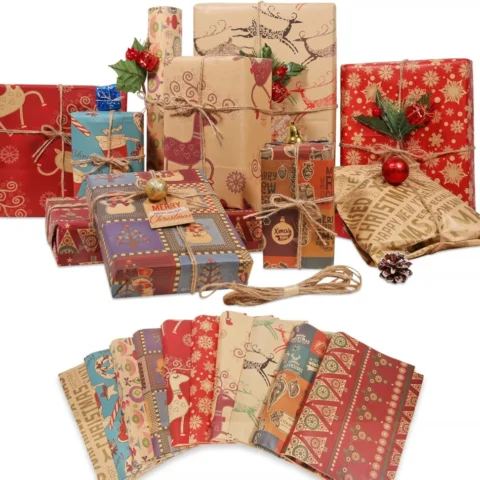
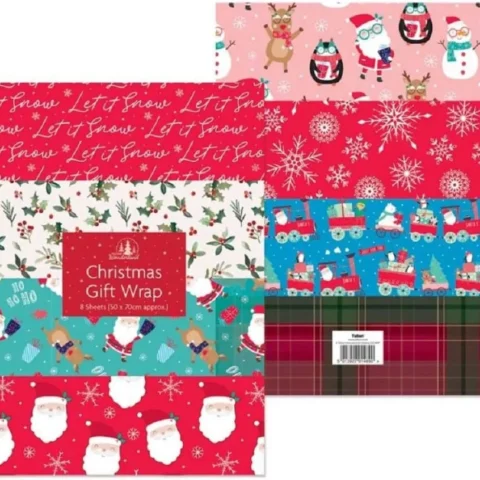
Cut triangles from offcuts of patterned Christmas wrapping paper, stick them on the card with a glue stick so they overlap into a tree, and finish with a brown paper trunk. Old carol sheet music cut the same way gives a vintage look.
7. Button tree
Arrange buttons in a triangle, largest at the bottom, and fix each one with a glue dot. Draw a trunk and a star, or use a star-shaped button at the top. Flat buttons keep the card slim, but check its thickness before you post it.
8. Cut-on-the-fold tree card
Fold the card and draw a tree on the front with the tips of its branches touching the folded edge. Cut through both layers round the outline, leaving the fold uncut where the branches meet it, so the card opens like a book in the shape of a tree. Draw or stick baubles on the front and write inside.
9. Pop-up card
This method needs two card blanks of the same size.
- Decorate the inside of the first blank.
- On it, draw a rectangle 2 cm wide and 5 cm long across the centre of the fold, so 2.5 cm sits on each side of the fold.
- Cut along the two long sides and score the two short sides.
- Open the card and push the rectangle through from behind so it folds the other way and forms a step.
- Stick the second blank to the back with double-sided tape to cover the cut.
- Glue a motif, such as a tree or a reindeer, to the front of the step, making sure it does not stick out when the card closes.
10. Snow globe shaker card
Cut a circle out of a square of card, stick clear acetate behind it and run foam tape round the circle on the back. Pour a spoonful of sequins or glitter into the well and seal it with a second square of card with a small snowy scene drawn on it, so the sequins move when the card is tilted. Mount the panel on the card front, then measure the thickness: foam tape adds a few millimetres.
Making handmade Christmas cards in a batch
- Cut and score all the blanks first, then decorate them one design at a time.
- Let paint and ink dry flat before you close the cards.
- For a printed batch, draw or paint one master design, scan it and print copies onto card, then add a hand-finished touch such as a gem or a bow to each.
- For relatives far away, print a family photo and mount it on a card blank with a border.
- Write the messages last. Our guide to what to write in a Christmas card has wording for family, friends and colleagues.
If the list is longer than your time, keep the handmade cards for close family and send a box of Christmas cards to everyone else. Gift tags, ribbon and paper for the rest of December are in the gift wrapping and cards range.
Peter Pauper Press
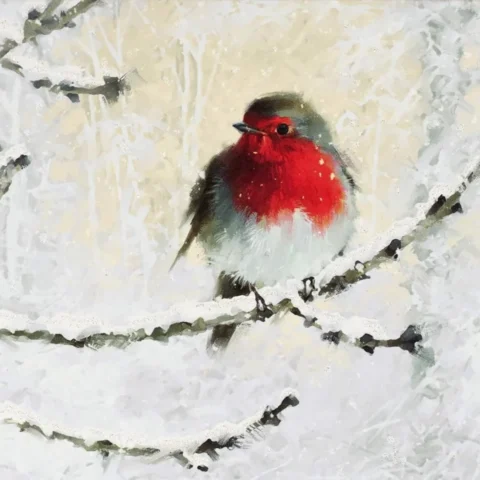
English robin Christmas cards, 20 with glitter and keepsake box
Just Cards Direct cards & gifts
Pack of 10 red candle Christmas cards with white envelopes, 14 cm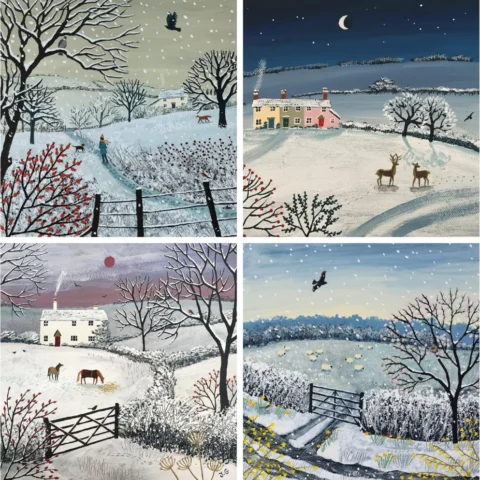
Absolutely Yours
Pack of 24 charity Christmas cards, 4 winter designs, 15 x 15 cm
Posting handmade Christmas cards
Royal Mail sorts post by size, thickness and weight. A flat handmade card is an ordinary letter; one with buttons or foam pads may not be.
- 24 × 16.5 cmmaximum size of a Letter
- 5 mmmaximum thickness of a Letter
- 100 gmaximum weight of a Letter
- 2.5 cmmaximum thickness of a Large Letter (35.3 × 25 cm, 750 g)
A card thicker than 5 mm needs Large Letter postage, so measure each one in its envelope at the thickest point. Then check the last posting dates for Christmas cards and plan the batch so it is finished in time.
Are handmade Christmas cards still worth sending?
Many people send fewer cards than they used to, but the habit is far from gone. In a November 2024 Saga survey of 3,000 customers, 94% still sent Christmas cards and 79% preferred a physical card to a digital one, although 54% planned to send fewer, with postage costs the reason most often given. Spending has held up: the Greeting Card Association’s market report put UK spending on greeting cards at over £1.5 billion in 2023, with sales up 4%.
A handmade card stands out in a smaller pile, and it is likely to be seen: 90% of the Saga respondents said they use the cards they receive to decorate.
Frequently asked questions
How do you make a simple Christmas card at home?
Score and fold a sheet of card, then add one motif such as a washi tape tree or a thumbprint robin. An A4 sheet folded in half makes an A5 card for a C5 envelope; half an A4 sheet folded makes an A6 card for a C6 envelope.
What card should you use for homemade Christmas cards?
Use card rather than paper: it stands up on a shelf and folds cleanly once scored. Choose a heavier card for designs with heavy layers or embellishments, and check the maximum paper weight in your printer’s manual before printing onto card.
Can you design and print your own Christmas cards?
Yes. Lay out the design at A5 or A6 size in any design program or word processor and print it on card your printer accepts, or print a photo and mount it on a card blank. To copy a hand-drawn design, scan one master and print the batch from it.
Do handmade Christmas cards cost more to post?
Only if they are thick or large. A Royal Mail Letter can be up to 24 × 16.5 cm, 5 mm thick and 100 g; anything thicker, up to 2.5 cm, goes as a Large Letter. Buttons, foam pads and shaker windows are the usual reasons a card crosses the 5 mm line.
Are Christmas cards a dying trend?
No, although many people send fewer than they used to. UK spending on greeting cards was over £1.5 billion in 2023, according to the Greeting Card Association. In Saga’s 2024 survey of 3,000 customers, 94% still sent Christmas cards, though 54% planned to send fewer.
What Christmas cards can young children make?
Handprint Santas, fork-print trees and thumbprint robins need no cutting and work with washable paint or an ink pad. Fold the blanks for them beforehand and leave the cards to dry flat before writing the messages.
What is proper etiquette for Christmas cards?
Write by hand, sign with names the recipient will recognise and post before the last recommended date. In Saga’s 2024 survey, 72% of customers wrote a simple greeting and 48% added a short news update.